
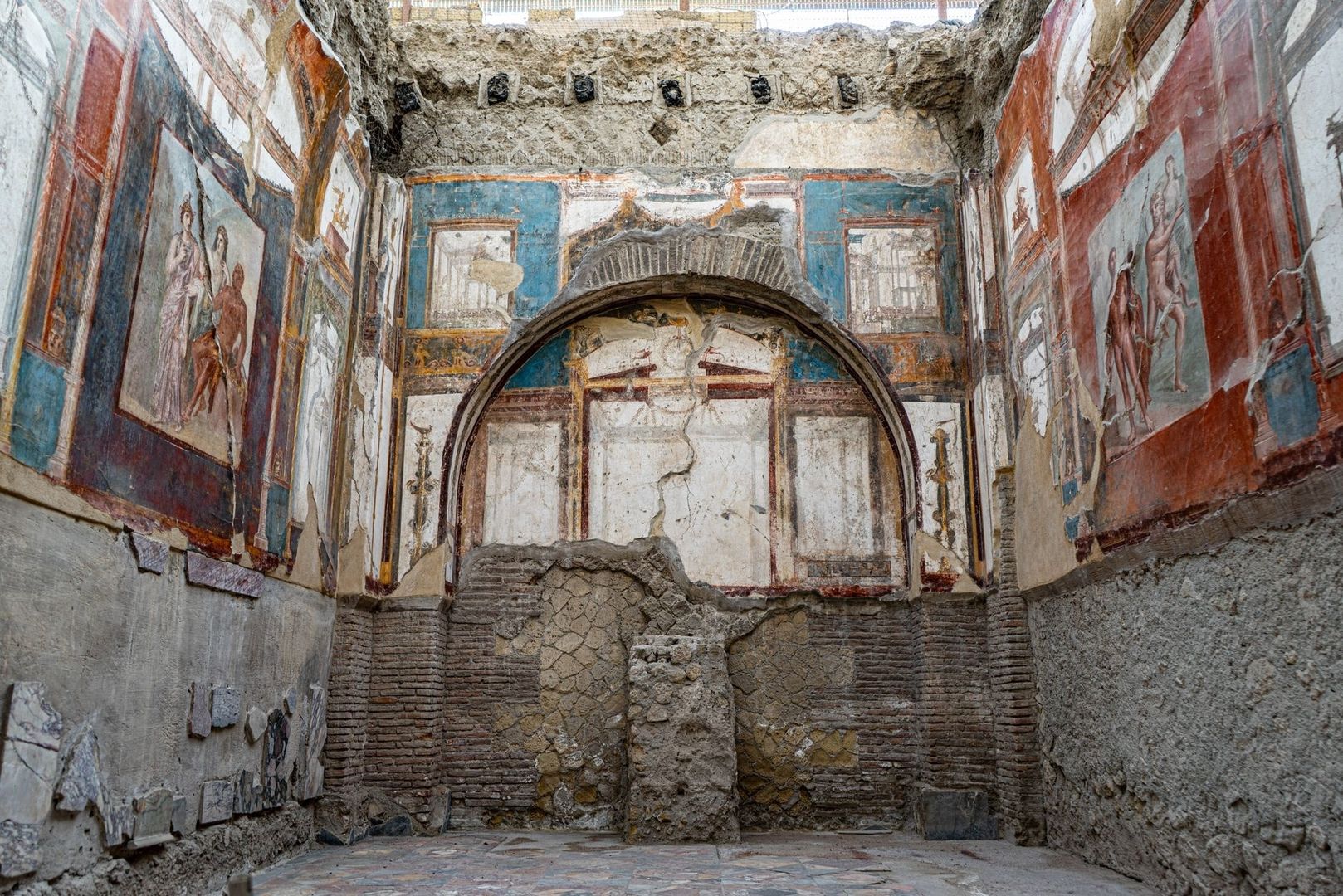
Buon fresco is an unusually intimate form of painting. The artist does not simply apply color to a finished wall. Pigment is brushed into a thin layer of fresh lime plaster while the surface is still damp, allowing the image to become part of the architecture itself. As the plaster dries, a chemical reaction binds the mineral color into the wall. The result is tactile rather than merely visual: a surface with the coolness of stone, the softness of earth, and a depth that seems to rise from within the building. For readers drawn to the relationship between material craft and lived space, buon fresco technique offers a precise lesson in how beauty can depend on timing, structure, and restraint.
In ancient Pompeii, that permanence served domestic display. Frescoes animated atria, dining rooms, garden courts, and private reception spaces, announcing the refinement, education, and wealth of the household that commissioned them. Centuries later, the same medium moved into schools, government buildings, factories, libraries, and streets, where it could address people who had never entered an aristocratic villa. The wall changed from a guarded sign of status into a shared surface for memory, identity, and dissent. Fresco”s transformation was therefore not only artistic. It was architectural and political, shaped by who was permitted to look, who was represented, and who could claim the city as a home.
Roman domestic frescoes were carefully integrated into the social choreography of the house. A Pompeian atrium was not a neutral room but a threshold where clients, guests, dependents, and political contacts encountered the owner”s cultivated image. Painted architecture could make a room appear larger, open onto imaginary gardens, or frame mythological scenes as if they were precious panels. The visual language was sophisticated, but its purpose was practical as well as decorative. Every wall helped establish rank, taste, and the household”s proximity to the cultural authority of Rome.
Elaborate pigment was especially effective because it converted expense into atmosphere. Strong reds, deep blacks, mineral blues, ochres, greens, and luminous whites could be arranged in architectural bands, delicate ornamental borders, theatrical figural scenes, or illusionistic vistas. Some colors were more costly or difficult to obtain than others, and the quality of the plaster preparation and brushwork signaled the competence of the workshop. Roman elites did not need to explain the value of such interiors. Their guests encountered it through movement, light, and controlled access.
This privacy matters when fresco is compared with later mural traditions. A Roman villa could be richly painted, yet the images were experienced by a controlled audience moving through a carefully ordered interior. The wall reinforced the boundary between those who possessed cultural abundance and those who entered only by invitation. Public murals would eventually reverse that arrangement. They would place complex imagery in the path of workers, schoolchildren, commuters, and neighbors, making visibility itself part of the political message.
The authority of fresco begins with preparation. A durable wall painting requires more than a smooth surface and attractive color. The wall must be sufficiently textured and absorbent to receive the plaster, while each layer must remain stable as moisture moves through the structure. A typical process begins with a coarse scratch coat made from lime, sand, and, in some modern workshop settings, cement. This first layer establishes grip and evens out irregular masonry. A further brown layer of sand and lime builds the body of the surface, after which the artist applies the fine intonaco, the painting coat made from lime and fine sand or marble dust.
The final surface must be judged by touch and by observation rather than by a simple clock. Too much water can make plaster weak or slow to accept pigment; too little can shorten the working period and make the brush drag. Artists may transfer a design by tracing or by pouncing charcoal through a perforated drawing. A preliminary verdaccio, or greenish underpainting, can establish values before more transparent layers of color are added. Such decisions make fresco resemble ceramics in one important respect: the image is built through controlled stages, but the material remains unforgiving once the process advances.
The term giornata, meaning “a day”s work,” describes the section of plaster laid down for a single session. Its size is a practical record of the artist”s pace, but it can also become part of the visible history of the wall. Edges between giornate may reveal how a large composition was organized, with major figures, architectural passages, and background areas divided according to the difficulty of the work. Painting over an area too soon can disturb the plaster, while waiting too long means the surface may no longer accept color properly. Fresco therefore turns time into a physical property of the image.
At the center of the process is carbonation, often called carbonatation. Slaked lime is calcium hydroxide. As the wet plaster is exposed to carbon dioxide in the air, it gradually changes into calcium carbonate, the principal mineral form of limestone. The pigment becomes locked into this newly formed crystalline structure rather than sitting as a detachable film on top. That is why a well-executed fresco can withstand gentle rinsing once sufficiently cured, while an incorrectly timed passage may powder, smear, or lose its intensity. The celebrated permanence of fresco is consequently not magic. It is a collaboration between water, air, lime, mineral color, and disciplined human timing.
The movement from Roman domestic painting to modern civic muralism involved a profound change in the wall”s social address. The technique could remain materially related, but its scale, setting, and audience changed. A villa fresco was commonly commissioned by an individual or household to refine a controlled interior. A twentieth-century civic mural was often conceived for a broad public, placed where daily movement made avoidance difficult. Its subject might include labor, migration, conquest, education, industrial production, or the struggle for political dignity.
| Feature | Roman aristocratic commission | Twentieth-century civic mural |
|---|---|---|
| Primary setting | Atrium, dining room, garden court, or private villa | Government building, school, union space, factory, or public passage |
| Substrate and preparation | Layered plaster adapted to domestic walls and carefully finished interiors | Large-scale plaster or prepared architectural surfaces designed for communal visibility |
| Intended audience | Guests, clients, patrons, and selected household visitors | Workers, residents, students, passersby, and civic institutions |
| Typical message | Learning, refinement, mythology, abundance, and household prestige | Collective history, labor, inequality, national identity, and social transformation |
| Meaning of permanence | Durable evidence of private wealth and cultural status | Durable evidence that communities, struggles, and excluded histories belong in public memory |
Physical permanence altered ideological significance because it changed what could be preserved and for whom. A patron”s interior might survive as evidence of one family”s aspirations. A civic mural could survive as a public argument, even when political conditions shifted. Its scale invited comparison between bodies, buildings, and institutions, while its fixed location connected historical narrative to the actual streets where people worked and lived. This is why preservation is never merely a technical concern. As the National Trust for Historic Preservation explains, preserving public art can help communities challenge cultural erasure, displacement, and the omission of marginalized histories.
The Mexican mural movement gave fresco a new public charge. Diego Rivera, José Clemente Orozco, and their contemporaries drew on European mural techniques while developing an imagery rooted in Mexican history, Indigenous visual traditions, revolutionary politics, and the dignity of labor. Their walls did not treat architecture as a passive support. The building became an active participant in the story, its corridors and monumental surfaces carrying images into the routines of civic life.
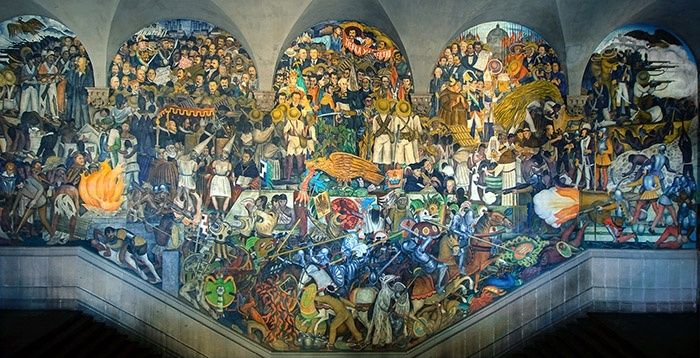
Rivera”s murals frequently connected pre-Columbian culture, industrial modernity, agriculture, and worker solidarity within expansive visual systems. Orozco brought a darker, more conflicted intensity to history and revolution, resisting sentimental accounts of progress and exposing violence, fanaticism, and the costs of power. Together, such approaches made the wall a place where national identity could be debated rather than simply celebrated. European artisan knowledge, including the discipline of working on wet plaster, met Mexican traditions of monumental image-making and public symbolism.
This participatory quality distinguishes public muralism from the carefully managed visibility of the Roman atrium. The viewer no longer needs an invitation from a wealthy household. The encounter occurs in shared space, and the image can provoke recognition, discomfort, debate, or solidarity. A mural may be commissioned by an institution, but its meaning is continually revised by the people who live around it. Public art organizations continue this work by treating walls as sites of memory and social action. The Social and Public Art Resource Center, founded in 1976, supports mural production, preservation, community history, and projects such as the Great Wall of Los Angeles, demonstrating how monumental art can keep contested narratives present across generations.
The political strength of fresco also lies in its vulnerability. A mural can be neglected, painted over, damaged by development, or altered by changes in ownership. Preservation therefore becomes a form of advocacy. Protecting a surface may mean protecting the people and events represented on it, especially when official histories have excluded them. The wall”s material continuity offers a point of resistance against disappearance, but only if communities, conservators, and institutions recognize that technical care and social justice are connected.
Fresco endures because chemistry and culture reinforce one another. Calcium hydroxide slowly becomes calcium carbonate, binding mineral pigments into a surface that can outlast its first patrons, political systems, and intended viewers. That physical process gives public murals an unusual authority. They are not simply images placed near architecture. They are architectural surfaces, carrying evidence of labor, weather, repair, neglect, and care. Their permanence mirrors the persistence of collective memory, while their material fragility reminds communities that memory still requires protection.
For the attentive viewer, the best way to read a fresco is to look beyond the scene. Notice the division of giornate, the grain of the plaster, the way color follows the curve of a wall, and the position of the image within daily circulation. Ask who commissioned the work, who was expected to see it, and whose story has been made visible. Whether encountered in a Pompeian house, a Mexican civic building, or a contemporary neighborhood mural, fresco shows that beauty can function as evidence. A wall may decorate a room, define a public place, or preserve a demand for justice. Its deepest achievement is to make community not only visible, but materially present.